Diesel Particulate Filter Explained
DPF… It’s a term that can appear at inconvenient moments, whether it’s on your dashboard, a repair bill you hadn’t budgeted for, or in conversation with a technician.
If you drive a modern diesel-engined car, you’re probably aware that it has a diesel particulate filter (DPF). What’s less clear for many owners is what the DPF does, how regeneration keeps it working, and what can go wrong.
A diesel particulate filter (DPF) catches tiny particles from the exhaust, known as particulate matter, commonly called soot. When the right conditions are present, heat inside the filter burns away much of the soot, a process called regeneration. Frequent short journeys can make regeneration harder to complete, as can faults elsewhere.
However, your vehicle’s DPF doesn’t do this job on its own. It’s one part of your car’s diesel emissions system, so other components can influence how much soot reaches the filter, or produce warnings that resemble DPF problems.
That’s why we’ll touch on those systems briefly as well to give you a more rounded understanding of your car’s DPF.
Throughout this expert guide, you’ll uncover how your diesel particulate filter works, which other systems can affect it, and the habits that help keep it working as intended.
Why Is There a Diesel Particulate Filter in Your Exhaust?
The DPF sits within the exhaust system, where it captures soot before it leaves the vehicle
DPFs became standard on most diesel cars as Euro 5 emissions rules were introduced. The rules began applying to new types of car in 2009 and to all new registrations from January 2011. They didn’t specifically require a DPF, but the tighter limits meant manufacturers generally needed to fit one.
Positioned in the exhaust, the filter traps tiny particles from the engine, formally known as particulate matter, before they can reach the air. That trapped material is commonly referred to as soot, the term we’ll use from here on.
Here’s what happens over time: as soot builds up, it becomes harder for exhaust gases to pass through the filter, and the DPF can become restricted. To help prevent this, the car burns away much of that soot at high temperature whenever the right conditions are met.
That process is called regeneration.
Euro 6 subsequently introduced tighter limits on nitrogen oxide (NOx) emissions.
Meeting those limits takes several emissions-control systems working together on most modern diesel vehicles, and within that line-up, the DPF plays a key role. Worth knowing, too: a missing or obviously modified DPF, where one was fitted as standard, can result in an MOT failure.
That’s the diesel particulate filter explained in its essentials. Now, let’s look at how regeneration works day to day, and the conditions it needs to complete.
How Does a DPF Work? Two Ways Regeneration Burns Away Soot
So, how does a DPF work? Inside is a honeycomb-like structure, usually made of ceramic, that collects soot as exhaust gases pass through. That design catches soot well, but the soot steadily builds up.
As the build-up grows, it becomes harder for exhaust gases to pass through, and the filter can become restricted. To keep it working as it should, your car burns away much of that soot when conditions allow, in a process called regeneration.
Regeneration usually takes one of two main forms:
- Passive regeneration: Soot is burned away naturally when exhaust temperatures are sufficiently high during normal driving.
- Active regeneration: The car raises the exhaust temperature to burn away soot trapped in the DPF. Exactly when and how it does this varies between vehicles. Some drivers may detect a slight change in the engine note or a rise in fuel consumption while it’s running.
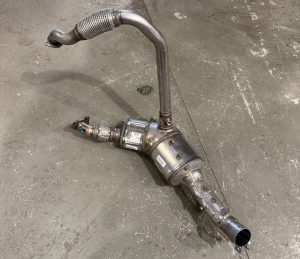
A removed DPF and exhaust assembly ready for inspection and servicing
Regeneration doesn’t remove everything, though. Ash, the non-burnable residue that collects in the filter over time, stays behind.
There’s one other thing to be aware of…
Switch the engine off before regeneration has finished, and the process is interrupted; some of that soot may remain in the filter. Repeat that pattern, and soot can keep building up; in time, your vehicle’s DPF warning light, or engine management light, may appear, and performance can be restricted.
What Repeated Short Journeys Do to Your DPF
It’s one of the most important things a diesel owner can understand, and it comes back to one question.
So, “Why does my diesel car need long journeys?”
…The short answer?
Regeneration needs time and the right conditions, and short trips offer little of either. School runs, trips into town, and stop-start errands can be over before the exhaust system has reached the conditions regeneration needs to complete. Interrupt it repeatedly, and soot can keep accumulating, eventually leading to warnings and the need for professional attention.
Your car’s DPF regeneration relies on suitable exhaust temperatures and operating conditions. Those conditions are more likely to be reached and maintained on one longer, continuous drive than across several short trips.
If a DPF warning light, engine management light or other alert has appeared on your dashboard, get in touch with our experts at PD Motors, Billingshurst, who can assess your DPF and advise on the next steps.
Why a Fault Elsewhere in the Emissions System Matters to Your DPF
Your DPF is one component within your car’s wider diesel emissions system, and what happens elsewhere in that system can affect how the filter performs.
Take the Exhaust Gas Recirculation (EGR) valve. Its role is to help reduce nitrogen oxide (NOx) emissions by recirculating a controlled amount of exhaust gas back into the engine. Over months or years, carbon deposits from soot and oil vapour can build up on it, leaving the valve restricted, slow to respond, or even stuck.
So why does this matter for your DPF?
Depending on the nature of the fault, an EGR problem can raise soot production, which in turn can place additional demand on your DPF.
It’s also worth noting that many modern diesel vehicles are also fitted with an AdBlue/SCR system to help control NOx emissions.
So what is AdBlue and why does it matter for your diesel emissions?
Injected into the exhaust system, AdBlue is a fluid that helps the Selective Catalytic Reduction (SCR) catalyst convert nitrogen oxides into nitrogen and water vapour. Your car monitors AdBlue fluid levels and warns you when it’s low.
On some vehicles, an empty tank or a detected fault can lead the system to restrict performance, or even prevent the engine from restarting. DPF and AdBlue faults can sometimes cause similar symptoms or bring up wider emissions warnings, and depending on what the car has recorded, a technician may need to check both systems.
Clues That Your DPF Might Need a Closer Look
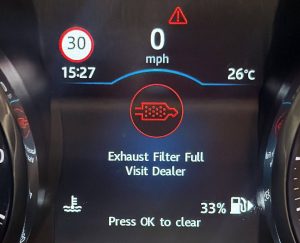
A DPF or exhaust-filter warning should be investigated rather than repeatedly ignored
A DPF fault may not be obvious at first, but your car will likely give you clues. Here’s what to look out for:
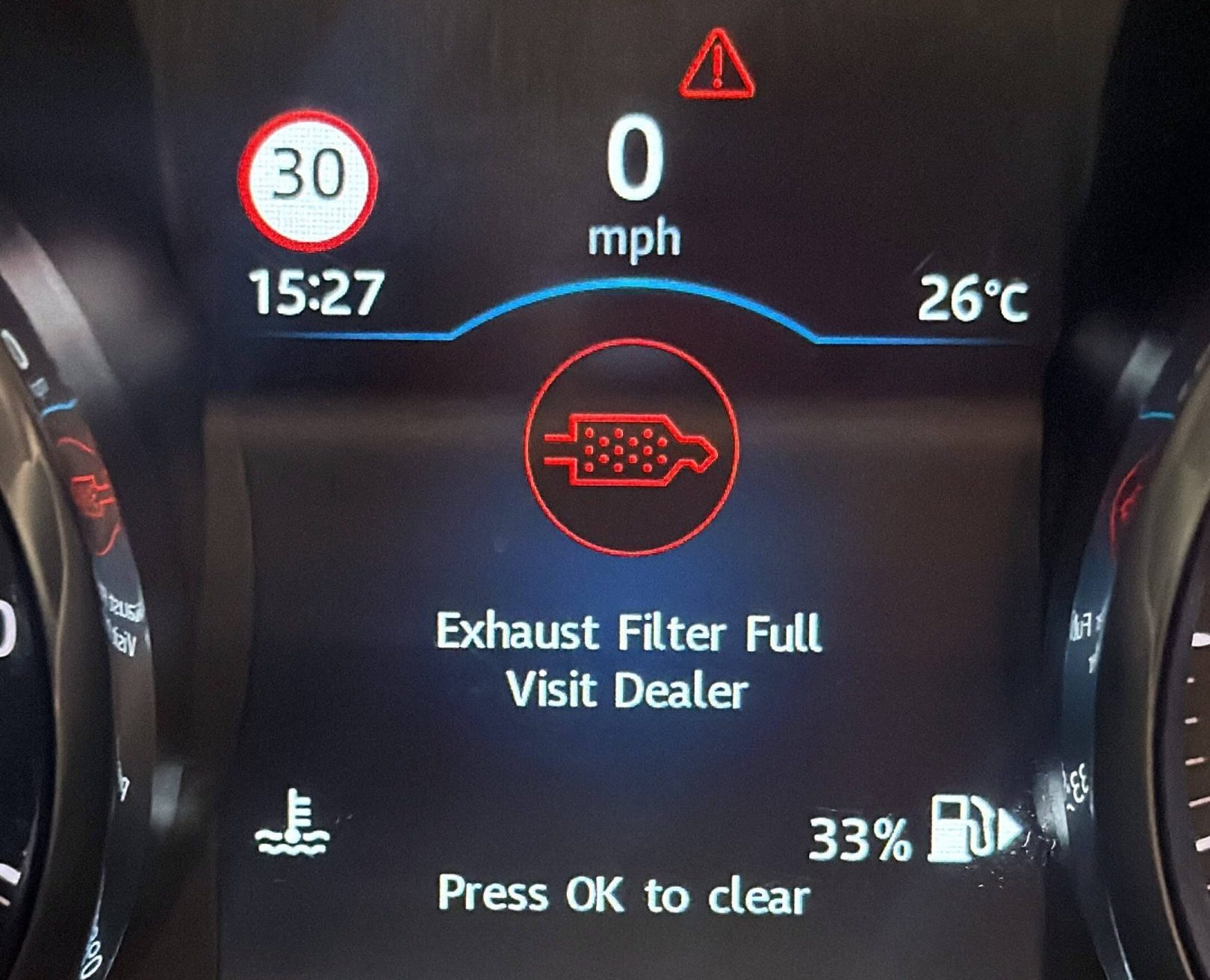
- DPF warning light (or other alert) on the dashboard: Excessive soot buildup in the filter can trigger this warning light, and so can a fault detected in the DPF itself or in the systems that monitor and manage it.
- Reduced engine power or limp mode: When it detects a fault affecting engine operation or emissions control, the engine management system may reduce performance.
- Increased fuel consumption: Repeated active regeneration attempts can increase fuel consumption because additional fuel may be used to help raise exhaust temperatures.
- Unusual exhaust smell or visible smoke: A strong smell or visible smoke from the exhaust can point to a fault affecting the engine or the emissions system, and it warrants investigation.
What matters is that these symptoms can overlap, and not all of them point directly to the DPF. Because a modern diesel engine relies on several interconnected systems working alongside the filter, identifying the cause requires an expert assessment.
If any of these sound familiar, speak to our experts at PD Motors, Billingshurst, who can take a closer look.
Three Habits That Support a Healthy DPF
The good news? You don’t need an engineering background to look after your car’s DPF. These three habits can make a real difference:
- Follow the advice in your vehicle handbook: A longer, uninterrupted journey may help the car complete regeneration, but only where the manufacturer recommends it and there’s no warning or fault that needs attention.
- Have a dashboard alert or DPF warning light looked at promptly: Persistent warnings, reduced performance or conflicting alerts need an assessment rather than another attempted drive, and delaying diagnosis can allow the issue to worsen into a more involved repair.
- Find an expert garage: The warning might point to one component when the real cause lies somewhere else in the system, and an expert assessment is the way to tell the difference.
With the diesel particulate filter explained and a few practical habits to maintain it, you’ll be in a stronger position to spot potential issues before they become more serious.
Why Choose PD Motors to Look After Your DPF?
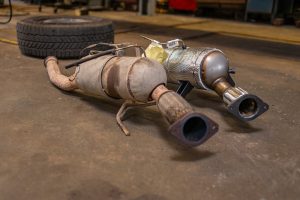
Depending on the fault and condition of the filter, DPF treatment may involve regeneration, cleaning or replacement
Now that you’ve had the diesel particulate filter explained, the next step is knowing where to turn if something isn’t right.
Not every DPF symptom is what you might initially think…
The warning that sent you searching for answers may have started with the filter, or with another part of the diesel emissions system. Only an accurate assessment by an expert can tell which is which.
This is why our technicians at PD Motors, Billingshurst, use their experience alongside manufacturer-level technology and tried-and-tested processes when tracing faults anywhere in the DPF or the emissions system around it. Once the cause has been found, our technicians can recommend the right repair, cleaning process or replacement, following the vehicle manufacturer’s guidance.
By choosing PD Motors, you’ll benefit from:
- Our technicians work with the same reference data and technology that the main dealerships rely on.
- Your repair is covered by our 12-month parts-and-labour guarantee.
- We can keep you mobile with a courtesy car while your diesel is with us.
- Experts serving Billingshurst, Horsham, Pulborough, Five Oaks and Worthing.
Join {{review-count}} other local Billingshurst drivers who’ve rated us {{average-rating}} stars on Google for straight answers, careful workmanship and excellent value.
Call 01403 786211 to arrange your DPF assessment with our experts at PD Motors, Billingshurst.
Call Now 01403 786211Save on Servicing
Frequently Asked Questions About Your DPF
What is a diesel particulate filter and why does my car have one?
A diesel particulate filter (DPF) became standard on most diesel cars as Euro 5 emissions rules came in, applying to new types of car from 2009 and to all new registrations from January 2011. It sits in the exhaust, where it captures particulate matter (soot) and prevents it from reaching the atmosphere. If one has been removed or tampered with, the vehicle can fail its MOT.
So, how does a DPF work? It relies on regeneration, which burns away much of the soot it has trapped at high temperature whenever the conditions allow. Usually, there are two main methods of regeneration, passive and active: the passive kind occurs while exhaust temperatures remain high enough to burn away accumulated soot, and in the active kind, the car raises the exhaust temperature itself, with exactly when and how varying between vehicles.
Why does my diesel car need long journeys to stay healthy?
Longer, uninterrupted journeys can help the vehicle reach and maintain the operating conditions needed for DPF regeneration, which is why your vehicle handbook may recommend them. Frequent short journeys can make successful regeneration more difficult, although faults within the emissions system can interfere with the process too, and no amount of driving will correct those.
How do I know if my DPF may be restricted?
A dashboard warning can be one sign of a DPF-related problem. Different vehicles have different alerts. Some have a dedicated DPF warning light, while others may illuminate the engine management light or display a different warning altogether. Reduced power, higher fuel consumption, or an engine that sounds or feels different can accompany it.
However, these signs aren’t proof that the DPF itself is at fault, because other issues can produce the same symptoms, so speak to our experts at PD Motors, Billingshurst, who will investigate and advise.
Can a DPF be repaired, or does it need replacing?
Not every DPF can be repaired, and the cause of the problem has to be found either way. A restricted filter may sometimes be cleaned if it’s otherwise in good condition, while a cracked, melted or otherwise damaged filter may need replacing. Bring your vehicle to our team at PD Motors, Billingshurst, for an expert assessment and a recommendation on the best approach.